
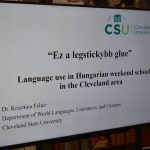
It was so good to see many members of the Hungarian Community hearing about the use of our ancient language in this particular diaspora. Our guest speaker and researcher was Dr. Krisztina Fehér, who was introduced by Mrs. Kuni Nádas, a member of the Museum’s Program Committee.
Dr. Fehér was still in Hungary in 2021 when she started research on the Cleveland area which has the largest Hungarian community in the U.S. One of the reasons she considered this study is because she felt that although there were books published on the history and culture of Hungarian communities, there were none on the language use itself.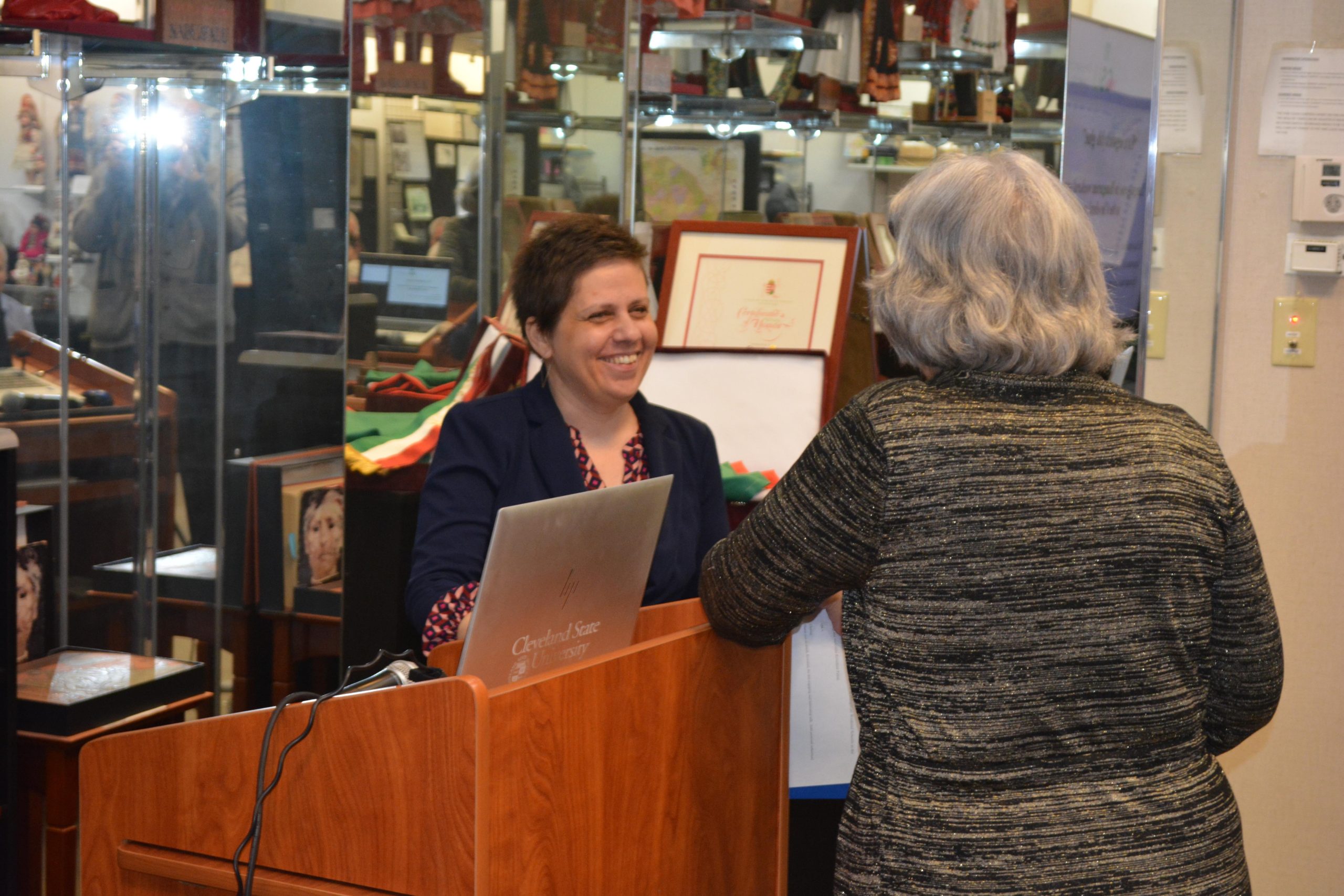
Her study included those persons who were familiar with the Hungarian language, or had Hungarian heritage and lived in the Cleveland area. Her subjects were children between the ages of 6-17 and teachers in the Hungarian schools.
Her study was a complex analysis with charts and categorizations to explain her course of action and its results about the children and teachers. She did field observations, linguistic landscape study, classroom observation and background questionnaires. She used the questionnaire format on two groups. In the first group (from parents) she had 544 submissions to an online questionnaire sent to participants throughout the United States. The second group of 68 participants (from students , parents and teachers) was limited to the Cleveland area The first group yielded quantitative subjective data and the second qualitative objective data. She also wrote about switching and mixing in the two languages.
There was so much more information. However, these are some of her findings:
- In the teachers’ group she found that there was more mixing of the two languages rather than switching the two. There was an element of judgement in the switching.
- In the students’ group, she indicated students preferred English and the switching was more common.
- Sample of Code-mixing is the phrase “Buckeye Magyar”
- “Formal forms” of the language has begun to disappear.
- Distinction between formal and casual use was discussed.
She also mentioned that there exists a bi-lingual mode in the brain and that the more bi-lingual a person is the more code-mixing there is. Also mentioned during the audience participation was that the language of counting determines the dominant language.




No comments yet.